US election: Clinton set to cement hold on nomination
Hillary Clinton is hoping to claim
victory in the race for the Democratic presidential nomination after six
states have finished holding primaries.
The Associated Press says
Mrs Clinton has already reached the 2,383 delegates needed, taking into
account pledges of support from so-called superdelegates.
She looks set to win New Jersey but the race could be tighter in the other big prize state, California.
Rival Bernie Sanders insists it is too early to call the result.
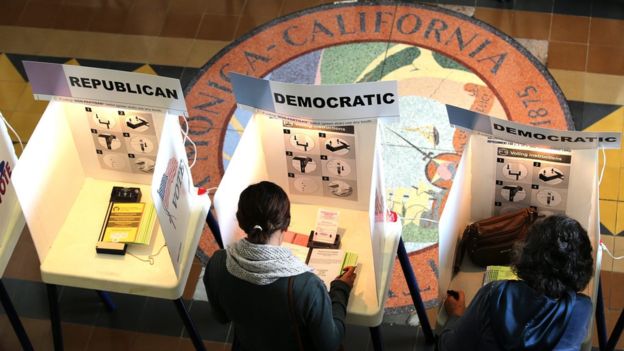
Republicans
are also voting in the same states, except North Dakota, although
Donald Trump has already secured the party's nomination.
His
recent criticism of a Hispanic judge was condemned on Tuesday by
Republican house speaker Paul Ryan as the "textbook definition of racist
comments".
'Unprecedented moment'
Voting
is taking place in Democratic primaries in Montana (27 delegates), New
Mexico (43) and South Dakota (25), with a caucus in North Dakota (23).
California has 543 delegates and New Jersey 142.
The final primary is in Washington DC on 14 June. It has 45 delegates.
AP says its count has Mrs Clinton on 1,812 pledged delegates and 571 superdelegates.
US media organisations say this means she will now become the first female nominee for a major US political party.
Superdelegates
are party insiders who can pledge their support for a candidate ahead
of the convention but do not formally vote for them until the convention
itself.
Analysis - Katty Kay, presenter, BBC World News
It has taken a long 227 years to get even this far.
George
Washington was elected president of a newly independent America in
1789. Forty-two men later (41 of them white) Hillary Clinton makes
history today by being the first female nominee for the White House.
So why don't I feel more excited?
The lack of exuberance may come from the fact that this has all been going on for so long.
We've
really been reworking a version of the "first viable female candidate
for the presidency" story since 20 January 2007, the first time Hillary
Clinton declared her candidacy for the White House.
We're
exhausted. We've run out of superlatives. We've overused every anecdote
from the former first lady, former senator, former secretary's
well-covered life.
A woman president would be new, Hillary Clinton is not.
Why aren't we more excited about Clinton?
BBC
North America editor Jon Sopel says the AP announcement could actually
be a problem for Mrs Clinton, as it may depress turnout in Tuesday's
primaries and creates the impression that she has only won because of
the superdelegates and not the ordinary voters.
The Democratic
Party has a far larger number of superdelegates than the Republicans,
meaning a candidate would have to win 58.8% of primary and caucus votes
cast under the party's proportional system to win by pledged delegates
alone. Mrs Clinton has about 55% of the overall vote so far.
She did not claim victory after the AP announcement, telling
supporters in Long Beach, California, on Monday: "We are on the brink of
a historic and unprecedented moment but we still have work to do.
"We have six elections tomorrow and we're going to fight hard for every single vote, especially right here in California."
Mrs
Clinton received another boost on Tuesday when the influential
Democratic politician and House Minority Leader Nancy Pelosi endorsed
her for president.
Outsider's campaign
Bernie Sanders is hoping for a victory in California to keep his campaign going to the party convention.
The Vermont senator has commanded huge crowds at his rallies, many of
them younger voters, pledging action on income inequality, minimum
wages and student tuition fees.
Reacting to the AP announcement,
Sanders team spokesman Michael Briggs said the media "is wrong to count
the votes of superdelegates before they actually vote at the convention
this summer."
He said Mr Sanders would attempt to win back superdelegates.
But
the BBC's Anthony Zurcher says Mr Sanders has been running an
outsider's anti-establishment campaign that has not generated much
enthusiasm among the Democratic power players and long-time party
stalwarts who comprise the bulk of the superdelegates.
AP reports White House officials as saying that Mr Obama is preparing
to endorse Mrs Clinton in the next few days, although the announcement
would come after Tuesday's primaries.
Mr Obama telephoned Mr Sanders on Sunday, AP said. The contents of the call have not been revealed.
'Textbook definition'
Meanwhile,
Mr Trump has faced a barrage of criticism from within the Republican
Party over his comments last week that Mexican-American US District
Judge Gonzalo Curiel was biased against him.
Mr Trump said Judge
Curiel, who is overseeing lawsuits against Trump University, would not
treat him fairly because he was a Mexican opposed to his plans to build a
wall between the US and Mexico.
Mr Ryan said he regretted Mr
Trump's comments, saying "claiming a person can't do their job because
of their race is sort of like the textbook definition of a racist
comment".
But he said it had not affected his decision to back Mr
Trump's candidacy. "We have more likelihood of getting our policies
enacted with him that we do with [Hillary Clinton]," he said.